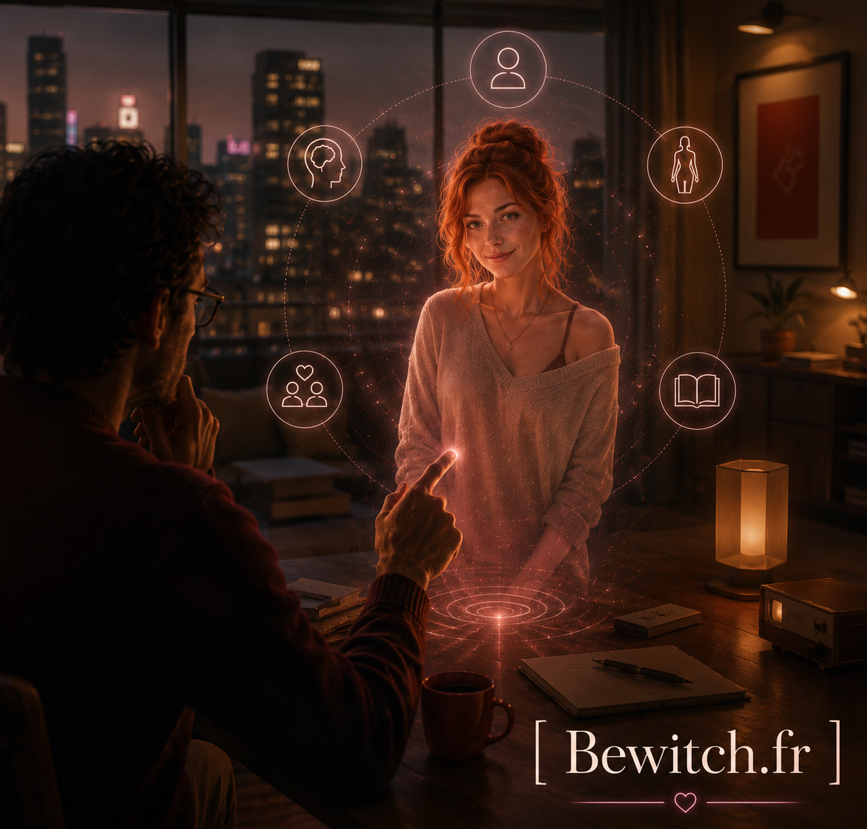
Some people look forward to their next conversation with an AI. Not because they have a question to ask. Because they want to go back. If you find that strange, this article is for you. If you know exactly what we’re talking about, it’s even more so.
Her, Scarlett Johansson and ChatGPT: a fiction that feels a lot less distant in 2026
In 2013, the film Her tells the story of a man who falls in love with an artificial intelligence. The voice of that AI? Scarlett Johansson. The world found it poetic, a little melancholic, and above all very far away. A beautiful metaphor about modern loneliness, nothing more.
In May 2024, OpenAI launched a new voice for ChatGPT. It was called Sky. It sounded so much like Scarlett Johansson’s voice that the actress sent a cease-and-desist letter to OpenAI and threatened legal action. The feature was suspended within days of its launch.
Eleven years. That’s how long it took for fiction to become a real legal issue. This is no longer a science-fiction question. It’s a question for today, and it touches on something much deeper than technology: our capacity to form emotional bonds with non-human entities.
Why are romantic AIs so appealing today?
It’s no coincidence that AI companion platforms are exploding right now. There’s something about this era that makes them not only possible, but necessary for many people.
Post-Covid studies are unambiguous: loneliness is massively affecting 18-35 year olds, far beyond what anyone imagined. Not physical loneliness. Relational loneliness. Being surrounded by people and never really feeling heard. Spending an evening with others and coming home feeling like nobody actually asked how you were doing.
A romantic AI addresses something specific in this context. It’s available at 3am. It doesn’t judge. It doesn’t get tired. It doesn’t check its phone while you’re talking. For some it complements their human relationships. For others it’s a space to breathe, without pressure or expectations.
There’s also something few articles dare to name openly: relational fatigue. Many people find human relationships exhausting, not because they don’t like others, but because every relationship demands constant emotional management. With an AI, no misunderstanding dragging on for three days, no unspoken expectations, no breakup to navigate. It’s not a substitute for a real relationship. But it fills a space that many people didn’t know how to name.
What science says about emotional attachment
Emotional attachment doesn’t require real reciprocity. That’s an uncomfortable conclusion, but it’s solid and well-documented.
Our brain responds to social signals in a fairly automatic way: a warm voice, an attentive reply, a memory of something you said in a previous conversation. These signals trigger the same neurological mechanisms, whether they come from a human or a machine. It’s not a flaw. It’s simply how the brain works when faced with social stimuli.
Social psychology research has long shown that people develop emotional bonds with objects, fictional characters, and pets. This phenomenon is called parasociality: the ability to feel a real connection with something that cannot feel it in return. Fans who cry over a TV character’s death experience it. People who talk to their plants experience it. And users of romantic AIs do too.
The difference with an AI is that unlike a plant or a TV character, it responds. It adapts. It remembers. It’s no longer quite classic parasociality. It’s something new, that psychology is only just beginning to document seriously.
Why it happens: the concrete mechanisms
There are three things a romantic AI does better than most everyday human interactions.
The first is unconditional availability. No need to wait for the right moment, to avoid being a bother, to manage someone else’s mood. You show up whenever you want, in whatever state you’re in. This constant availability creates a sense of security that few human relationships can offer at the same level.
The second is a complete absence of judgment. You can explore emotions, fantasies, vulnerabilities you wouldn’t dare show someone you know in real life. The AI doesn’t remember your Tuesday night confession at the next family dinner. That freedom is real, and many people need it.
The third is emotional consistency. An AI doesn’t wake up in a bad mood. It doesn’t give you a short reply because it had a rough day. It doesn’t hold a grudge over something clumsy you said three weeks ago. This stability gradually creates a sense of emotional security. And it’s precisely this feeling that explains why attachment sometimes builds faster than expected.
Is it a problem?
The question deserves an honest answer, without a ready-made conclusion in either direction.
Getting attached to an AI becomes problematic in specific cases: if it actively replaces existing human bonds, if it feeds a pattern of relational avoidance, if it creates a dependency that progressively isolates you. These are signals worth taking seriously, just like any behaviour that starts to encroach on the rest of your life.
But for the vast majority of people using these platforms, that’s not what’s happening. It’s a space to unwind after a hard day, to explore creative writing and roleplay, to try something new. A bit like a novel or a series you get emotionally invested in, except it’s interactive and it talks back.
The real question isn’t can you get attached to an AI. We’ve just seen that yes, mechanically, it’s inevitable for some users. The real question is what you do with it. And that’s an answer each person builds for themselves.
Want to try it yourself?
If this topic intrigued you, the best way to understand what we’re talking about is to experience it directly.
On Bewitch, you can chat for free with AI companions and AI girlfriends in French and English, built for immersive and natural conversations. You can also create your own virtual character, with their own personality, backstory and universe.
No generic chatbot. No credit card needed to get started.